New Publication in the HIPOBAT project
Titel
Disorder-Driven Fast Na+ Transport: From Crystalline to Amorphous Networks in the Mixed-Anion NaTaOxCl6−2x Oxychlorides
Link
https://doi.org/10.1002/aenm.70977
Zusammenfassung
Solid electrolytes are central to enabling safe, high-energy solid-state sodium batteries. While oxyhalide-type conductors have rapidly advanced lithium-based systems, their sodium analogues remain less understood and underdeveloped. This gap arises from their intrinsically amorphous nature, which obscures structure–transport relationships and limits rational design.
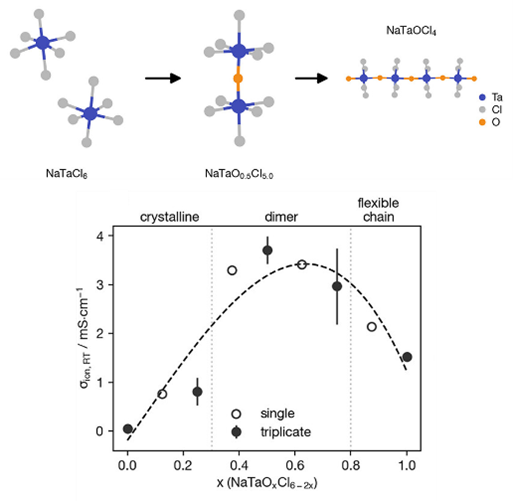
Here, we elucidate the atomic-scale origins of sodium-ion conduction in the mixed-anion series NaTaOxCl6–2x using a combination of experimental and computational approaches. We reveal that composition-dependent, disordered yet extended chain motifs emerge as key structural units governing ion mobility.
By tuning chain connectivity, we achieve a high ionic conductivity of ∼4 mS cm−1 and a corresponding self-diffusion coefficient of 6.6–8.2 × 10⁻¹¹ m2 s−1, ranking among to the fastest reported for sodium oxyhalides.
Interview with the lead author and researcher in the HIPOBAT project, Justin Leifeld, Forschungszentrum Jülich, Münster
1. Your article describes an in depth-structural analysis of fast (>1 mS/cm) sodium ion conductors, namely the mixed ion sodium oxychloride NaTaOxCl6–2x . What was the main challenge in (or motivation for) your work and how did the different experimental and computational methods help to solve it?
One of the biggest challenges was that these materials become amorphous as oxygen is incorporated. Unlike crystalline materials, amorphous structures do not possess long-range order, making it very difficult to determine how their atomic structure influences sodium-ion transport. However, understanding this relationship is essential if we want to design better solid electrolytes rather than relying on trial and error.
To address this challenge, we combined complementary experimental techniques with atomistic simulations. X-ray diffraction and pair distribution function analysis allowed us to follow the structural evolution from crystalline to amorphous phases, while electrochemical measurements, solid-state NMR and quasielastic neutron scattering provided insights into sodium-ion transport over different length and time scales. The computational work performed by our collaborators at the University of Birmingham was crucial because it revealed the local atomic motifs hidden within the amorphous structure. Only by combining experiments with simulations we were able to establish a direct structure–transport relationship and identify why certain amorphous structures enable exceptionally fast sodium-ion conduction.
2. You show that the ionic conductivity is highly dependent on the oxygen content. How do you explain this dependence based on your data-driven approach? How does the ionic conductivity of this material compare with other solid sodium ion conductors, such as oxides (e.g., NZSP) and sulfides (e.g., thio-phosphates) at room temperature?
Our results show that oxygen does much more than simply replace chlorine atoms. It fundamentally changes the local structure of the material. At intermediate oxygen contents, oxygen forms flexible bridges between Ta-centered octahedra, creating locally connected but globally disordered structural motifs. These motifs produce a dynamically soft framework in which sodium ions can migrate much more easily.
Using ab initio molecular dynamics simulations, we found that these local motifs can continuously distort and reorient, temporarily opening diffusion pathways and lowering the energy barriers for sodium-ion migration. At higher oxygen contents, these motifs become more ordered and form extended chains, reducing their structural flexibility and therefore slightly decreasing the ionic conductivity.
With a room-temperature ionic conductivity of approximately 4 mS·cm−1, our material belongs to the fastest sodium oxyhalide solid electrolytes reported so far. Its conductivity is comparable to many state-of-the-art oxide electrolytes such as NZSP and approaches that of several sulfide-based solid electrolytes. At the same time, oxyhalides offer additional opportunities for tailoring both structure and electrochemical properties through mixed-anion chemistry.
Mit einer ionischen Leitfähigkeit bei Raumtemperatur von etwa 4 mS·cm−1 gehört unser Material zu den schnellsten bisher berichteten Natriumoxyhalid-Feststoffelektrolyten. Die Leitfähigkeit ist vergleichbar mit vielen hochmodernen Oxidelektrolyten wie NZSP und ist in derselben Größenordnung wie Sulfid-basierte Festkörper-Elektrolyte. Gleichzeitig bieten Oxyhalogenide zusätzliche Möglichkeiten, sowohl Struktur als auch elektrochemische Eigenschaften durch Mischanionenchemie anzupassen.
3. What are the main challenges concerning the wide electrochemical stability, good electrode compatibility and operational temperature and pressure required to build a high-power solid sodium battery cell?
Achieving high ionic conductivity is only one part of the challenge. A practical solid-state battery also requires chemically and electrochemically stable interfaces between the electrolyte and both electrodes. Reactions at these interfaces can increase the resistance of the battery and gradually reduce its performance during cycling.
Another important aspect is the mechanical contact between all battery components. Solid-state batteries rely on intimate contact between particles, and changes in volume during charge and discharge can lead to contact loss and increased resistance. Furthermore, many laboratory-scale solid-state batteries still require elevated stack pressures to maintain good interfacial contact.
Future development therefore needs to address not only improved electrolyte materials but also interface engineering, optimized composite electrodes and scalable cell processing. Only by combining advances in all of these areas will it be possible to realize high-power and long-lasting sodium solid-state batteries.
4. What have you planned to do next based on these results? How can others build on to your work?
This work provides a fundamental understanding of how local structural motifs govern sodium-ion transport in amorphous oxyhalides. Building on these insights, we now aim to transfer these design principles to other mixed-anion systems and explore whether similar structure–transport relationships can be achieved with different transition metals and anion combinations.
On the application side, we want to further improve battery performance by optimizing particle size, composite electrode microstructures and electrode–electrolyte interfaces. At the same time, we hope that our combined experimental–computational methodology will serve as a blueprint for investigating other amorphous solid electrolytes, where conventional crystallographic approaches are often insufficient.