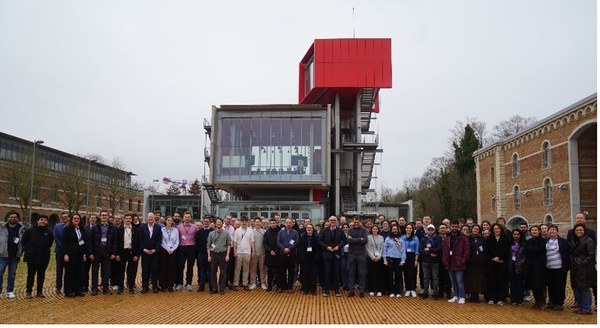
HIPOBAT Workshop in Amiens, France
Amiens and Paris, France, 18.02.- 19.02.2026
On 18th and 19th February, the HIPOBAT project partners gathered in Amiens at the Laboratoire de Réactivité et de Chimie des Solides LRCS to discuss the mid-term results of this bilateral research project. The Franco-German research cooperation HIPOBAT works towards the development of high-power sodium (solid-state) batteries based on optimised electrode and solid electrolyte materials, cell concepts and characterisation protocols.
In Amiens, the focus was on the work of early career researchers (ECRs). After the welcome address by Xavier Montagne (Ministère de l'Enseignement supérieur, de la Recherche et de l'Espace), Dr. Jan Henning Behrens (Bundesministerium für Forschung, Technologie und Raumfahrt), and Denis Postel (Président de l'Université de Picardie Jules Verne) and the project coordination overview, the ECRs presented their progress in a poster competition. The high quality and tremendous variety of the poster contributions was highlighted by the scientific and industrial advisory board.
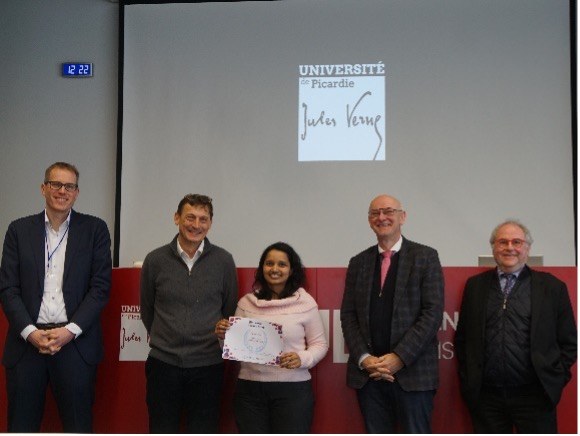
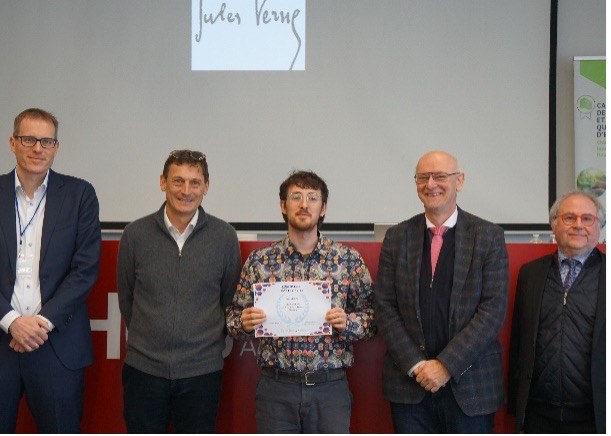
Dr. Anjali Gaur at Sorbonne Université and Kilian Vettori at Justus-Liebig-Universität Giessen, won this first HIPOBAT poster competition, with their presentations on “Understanding Structure–Diffusion Interplay in Crystalline vs. Disordered Li/Na Metal (Oxy)halides using Machine Learning Potentials” and “Quantifying Static Capacity Losses in Solid-State Battery Composites via Coulometric Titration Comparison”, respectively. Congratulations to both.
On the evening of 19 June, the German embassy in Paris invited the core of the HIPOBAT consortium to a panel discussion titled “From research to industry – Franco-German perspectives on strengthening European competitiveness in battery technologies”. The panel was composed of top-class speakers, namely Dr Corinne Borel (Head of the unit Research and Innovation Strategy in the French Ministry of Higher Education, Research, and Space), Benoit Lemaignan (CEO of Verkor), Dr Alexandra-Gwyn Paetz (Head of the unit Technological Sovereignty and Innovation in the German Federal Ministry of Research, Technology and Space), Prof. Monika Schnitzer (Co-Chair of the Franco-German Council of Economic Experts and Chair of the German Council of Economic Experts) and Dr Mathieu Morcrette (HIPOBAT coordinator on the French side and CTO of TIAMAT), who moderated the vivid and stimulating round table discussion.
The panelists agreed that batteries are a key technology in many important sectors, such as mobility, renewable energy, and defence. The strategic nature of batteries mean that their production cannot be fully outsourced to non-European players as this would undermine European sovereignty and competitiveness. The global competition is fierce but it is not too late to establish a competitive European battery ecosystem if the necessary actions are taken.
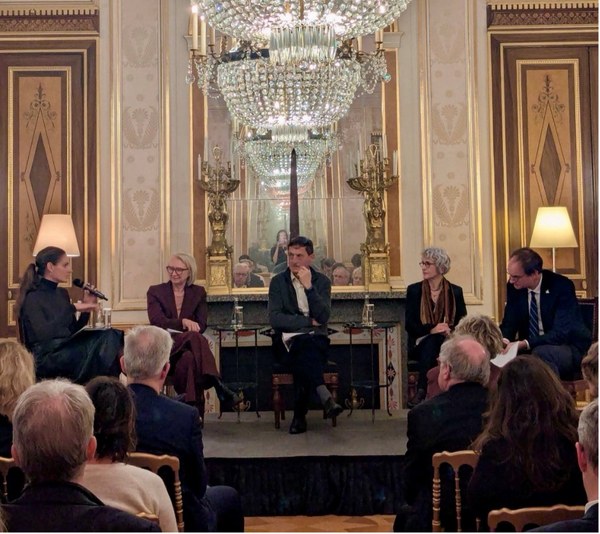
The speakers highlighted the strong scientific contributions by EU-based researchers in the field of batteries as witnessed in the ongoing HIPOBAT project. Europe, however, is lagging behind Asian players in transferring results in battery science to industry and in upscaling battery technology. To overcome this bottleneck organizational and legal hurdles need to be removed so that collaborations can be effective. The panelists agreed that a European battery ecosystem is needed and that securing the material supply chain is a crucial challenge that encourages collaboration among industrial actors. The panelists also touched upon the importance of innovation in fields that are adjacent to battery manufacturing, such as AI and robotics.
This stimulating exchange made clear that both France and Germany are committed to foster a European battery industry by streamlining organizational processes and by intensifying both scientific and industrial collaborations in the near future. HIPOBAT is clearly opening the way in this direction.
We already look forward to the next HIPOBAT workshop, which is going to take place in Münster, Germany.