Exchange Program for HIPOBAT Researchers
Research Exchange at the PHENIX Lab of the Sorbonne University in Paris
Beyond the scientific work, I learned a lot about the French system of doctoral studies and research. One day, I ran into some people in the hallway who were on their way to such a meeting. I spontaneously joined, even though I didn’t know what the topic was. I sat down and looked at the title: “Bienvenue au Meeting de la Physique Statistique.” Sure. All I knew about statistical physics was that there is the Schrödinger equation, which describes certain relationships here. Now I even know what the Schrödinger equation is exactly used for!
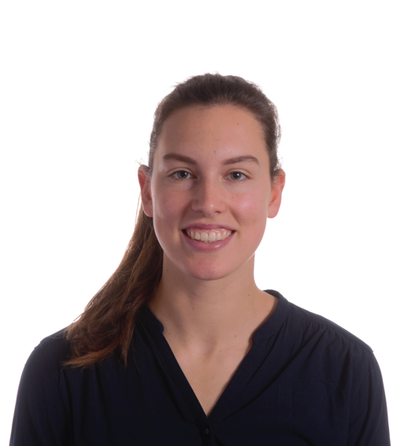
Within the HIPOBAT project all doctoral students and post-docs have the amazing opportunity of spending a couple of months at a partner lab in France or Germany. Caroline shares a bit about this great experience at PHENIX lab at the renowned Sorbonne University in Paris.
Why did you want to go to the PHENIX lab in Paris?
Here in Braunschweig, Germany, I am working on simulating the electrode structure formation during the electrode’s manufacturing process. When the structure is created, I am simulating its overall electronic and ionic conductivity, to assess which electrode structure leads to the highest performance. In HIPOBAT, we look at sodium solid state batteries, which require a solid electrolyte that conducts sodium ions. Here at IPAT, we chose the polymer PEO as the solid electrolyte matrix. Very little is known about the diffusion of sodium ions in PEO. Therefore, I wanted to simulate the sodium ion diffusion in PEO on an atomic scale, to take this diffusion coefficient as input parameter for my large scale electrode conductivity simulations.
How did you start organizing this exchange?
Since I knew the project allowed me to spend some time abroad, I checked the work packages of every French institute and saw that a stay at PHENIX would allow me to carry out the kind of simulation I was looking for. At the HIPOBAT Kick-Off Meeting in Paris in November 2024 I talked to Alessandra Serva, the group leader of the PHENIX team within HIPOBAT. Alessandra was very nice to me and said that it will be possible. She just asked for a small project outline, which I sent to her, and then we were all set to discuss the exchange dates.
Did the stay help you with your research?
Yes, it definitely helped my research. I learned a lot and even though I did not fully finish what I started, I will continue working on it from time to time in parallel to my current work and I am sure, that I will have some usable results in a couple of weeks. With this, my thesis will have (even) more scientific depth and cover a wide range of simulation techniques. We are one step closer to fully assessing battery performance entirely through simulations.
Tell us some further impressions of your stay at PHENIX.
Beyond the scientific work, I learned a lot about the French system of doctoral studies and research. As always, there are differences and similarities to the system at home.
Exactly like at home, there are team meetings where researchers present their work or their latest progress. One day, I ran into some people in the hallway who were on their way to such a meeting. I spontaneously joined, even though I didn’t know what the topic was. I sat down and looked at the title: “Bienvenue au Meeting de la Physique Statistique.” Sure. All I knew about statistical physics was that there is the Schrödinger equation, which describes certain relationships here. On the first slide, there was indeed an equation I recognized. After that, however, I got lost in a sea of electron probabilities. Still, it was an exciting insight with an interesting follow-up discussion. Now I even know what the Schrödinger equation is exactly used for!
Otherwise, the same topics as at IPAT are discussed. Who is going to which conference? Who knows how to operate which equipment? Or, specifically for simulations, who needs how many hours of computing time and are our servers sufficient? But also: who didn’t clean the lab, and why is the coffee machine broken again? Lunch is usually eaten in the cafeteria. And this is where the differences with TU Braunschweig begin. Water pitchers are on every table, baguette is of course also provided for free—what would the French do without baguette?—and occasionally there are moules frites, i.e., mussels with fries. A classic in France. The starters like quiche or terrine and desserts like tarts and éclairs every day also confirm every cliché. I loved it!
Another difference from IPAT that I notice here is the way of working. Hardly anyone is in meetings. Everyone works independently, and every two weeks the progress is presented to the research group, during which questions can also be asked. Although everyone works individually, all topics are so closely related that each meeting provides a lot of detailed input. I joined several regular online meetings with my colleagues from IPAT while I was at PHENIX. These were our competency team meetings, working group meetings, assistant rounds, or other content-related discussions. Here, everyone jokingly thinks I work in a call center…
At the beginning of October, the 2025 Nobel Prize in Chemistry was announced and awarded to the three researchers Susumu Kitagawa, Richard Robson, and Omar M. Yaghi for their research in the field of metal-organic framework compounds. The group in the office next door also researches exactly these kinds of compounds, so the news caused great excitement throughout the institute. During the following lunch breaks, there were many discussions about whether this area would now receive more attention and whether more research funding might become available. A celebratory meal was even held, and my office colleague proudly told me that she had taken a photo with one of the laureates at a conference. Research here is pursued with real passion, which is quickly contagious.
Do you think you will stay in contact? Do you have further ideas for collaborations and publications?
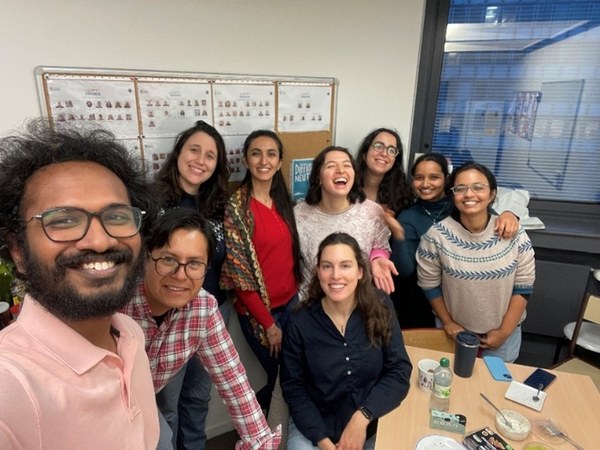
Since I met so many nice people at PHENIX, I am sure, that we will stay in contact. Not only because we are working in the same project, but also because we had interesting and funny discussions every time, we had lunch or dinner together. I am happy I met so many people from all over the globe and that I learned so much about Indian, Spanish and Persian culture. I thought it was funny to explain the French Revolution to people, that did not learn this in school, since their cultures have other important historic events. Vice versa, my colleagues, and now friends, thought it was funny, that I have never tasted rose ice cream with carrot juice as topping.
But back to work. I am still in contact with a couple of people, since we want to write a publication together. Or course, it will still take us a couple of weeks, but since this simulation technique was really new to me, I did not expect to publish something within the three months anyway.
I am extremely grateful to Alessandra, my group leader there, that she introduced me to her group immediately and was always available for questions. She is very experienced in molecular dynamic simulations and will be a large part of a successful project finalization. Equally, I am so happy that everyone in the lab was open to answer my questions and therefore made the start of my scientific work and social life there so much easier!