New Publication in the HIPOBAT project
Title
Prediction of Structural Stability of Layered Oxide Cathode Materials: Combination of Machine Learning and Ab Initio Thermodynamics
Link
https://doi.org/10.1002/aenm.202505470
Summary
Layered oxides have caught much attention as cathode materials for Na-ion batteries. For a rational cathode material design and performance improvement, accurate prediction of the most stable stacking sequence (e.g., P2 vs. O3 phase) of layered oxides is inevitable.
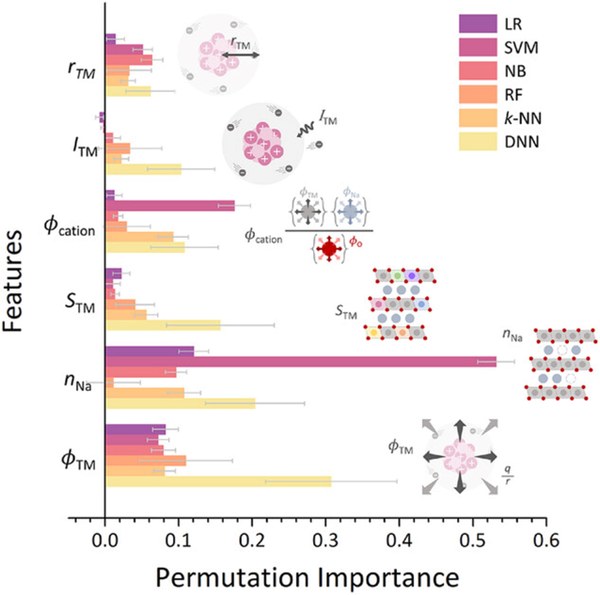
Here, we first developed a data-driven model based on machine learning (ML) to predict the phase stability of layered oxides. Afterward, with combination of electrostatic analysis, density functional theory, Monte Carlo simulation, and thermodynamics consideration, we validated our ML-based prediction and gained insight into the interrelation between features and phase stabilities. We found that deep neural networks can predict phase stability with a very high accuracy. Transition metal (TM) ionic potential, Na concentration, and TM mixing entropy are identified as the key factors influencing phase classification, with lower TM ionic potential, higher Na content, and higher mixing entropy favoring the O3 phase. We found that Na-TM and Na-Na interactions are key factors controlling the phase stability and both are strongly Na concentration dependent. Finally, the TM ionic potential is determined to be the decisive factor controlling Na-TM interaction and thereby the phase stability of layered oxide cathode materials for Na-ion batteries.
Interview with one of the authors and researcher in the HIPOBAT project, Dr. Dijana Milosavljević, Forschungszentrum Jülich
1. You have developed data-driven models based on machine learning (ML) and ab initio atomistic thermodynamics approaches to predict and understand the phase stability of a specific class of cathode active materials for sodium-based batteries, namely layered oxides. To construct the database of 270 compounds for your work, you started from an already existing one with 104 compounds. Can you explain why it was necessary to extend the existing database. What was the main challenge to construct this database? How long did it take you to construct it and will other researcher be able to use it in the future?
While the existing database provided a solid foundation, it is important to emphasize that improving the model’s accuracy, quality, and predictive performance required increasing both the quantity and the quality of the data in the database. Furthermore, the novelty of our database lies in its inclusion of samples with low Na concentrations. The primary challenge in developing the database is data availability, which requires either close collaboration with experimental groups or an extensive and detailed review of the existing literature. This process is time-consuming and demands careful data evaluation. We will address these issues in one of our upcoming publications. The construction of the database was initiated by Konstantin Koester from FZJ. It was subsequently updated by the other coauthors. Additionally, our new database encompasses multi-element compounds, broadening its scope and applicability.
2. How does the ML model you used and trained differ from other works in the field? What are the 6 linearly-independent features that are at the core of your model?
The most prominent earlier study investigating the factors that influence the phase stability of layered oxides is “Rational design of layered oxide materials for sodium-ion batteries” by Zhao et al. published in Science in 2020, where the cationic potential was first introduced as a novel predictor for the formation of the layered oxide phase. However, it should be emphasized that the study did not include other factors to enable comparison. The novelty of our work lies in the inclusion of additional features, such as the mixing entropy of transition metals (TMs), and in the decoupling contributions of Na and TMs as ionic potential, which cannot be separated when using the cationic potential, where both contributions are inherently intertwined. Our results demonstrate higher accuracy than those reported in the previous publication, indicating advancement over earlier findings.
3. Your work focuses on compounds which are either P2 or O3. Can you briefly explain what is the difference between the two and what you found out in terms of the formation of either P2 or O3 phases – what are the decisive features for phase preference? How can this help researchers synthesizing and testing cathode active materials for sodium-based batteries in the HIPOBAT project?
The P2 phase has prismatic Na-ion sites, a two-layer oxygen stacking sequence, and typically shows faster Na-ion diffusion, whereas the O3 phase has octahedral Na-ion sites, a three-layer oxygen stacking sequence, and provides higher structural stability but comparatively slower ion diffusion. Our model achieves an accuracy of approximately 96% in predicting phase stability (P2 versus O3). TM ionic potential, Na concentration, and TM mixing entropy were identified as the key descriptors determining phase classification, where higher TM ionic potential, lower Na content, and lower mixing entropy favor the P2 phase. Additionally, we have implemented our machine-learning model into a publicly available phase predictor (https://huggingface.co/spaces/LIANGTING-WU/Phase_Predictor), where the resulting phase can be predicted simply by specifying the chemical formula. This practical tool enables researches to quickly determine the phase of their targeted compositions, representing a significant contribution to material synthesis and accelerating materials design.
4. You have made an effort to create an extended database of P2 and O3 compounds, to compare different machine learning models, and to train and validate the DNN model. What will be the next steps? Have you planned additional steps to extend this workflow/model to other phases or other compounds in the future?
Currently, we are finalizing a paper on a new ML model for phase transition prediction. For this purpose, we have created a new database containing information on compounds during electrochemical cycling. The development of the dataset posed significant challenges due to the absence of any previously available dataset. Additionally, it would be worthwhile to explore alternative stacking sequences, such as P3, or layered Na-ion cathodes that exhibit mixed P2/O3 phases formed during synthesis. However, obtaining a reliable prediction would require a substantially larger body of experimental data, as these classes of materials remain highly underrepresented in the current literature. Additionally, since our P2 versus O3 database is publicly available, it can be continuously updated to include newly synthesized compositions, which can be used to re-train the model and incorporate additional features.